
Sample Data for Set Operations in Python
In this lecture, we will learn about set operations.
The data used in each operation consists of the following two sets:
A = {1, 2, 3, 4}
B = {3, 4, 5, 6}
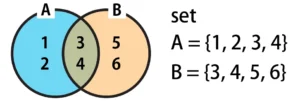
The variable "A" contains the numbers 1 to 4, which are represented by the blue outline in the Venn diagram.
The variable "B" contains the numbers 3 to 6, which are represented by the orange outline in the Venn diagram.
Both variables "A" and "B" share the common values {3, 4} (the overlapping area in the Venn diagram).
How to Find the Union of Sets in Python: Operator |
The union returns the combined range of values contained in A and B. In the Venn diagram, this is highlighted in green below.
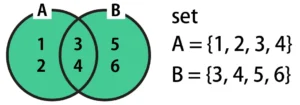
To compute a union in Python, place a | (Vertical bar) between A and B, as shown in the code below.
A = {1, 2, 3, 4}
B = {3, 4, 5, 6}

union = A | B
print("union:", union)  # {1, 2, 3, 4, 5, 6}
Writing A | B creates a new set representing the union, which is assigned to the variable "union". The result is {1, 2, 3, 4, 5, 6}. (This behavior, where a new set is created by the operation, also applies to intersection, difference, and symmetric difference.)
Note that the common values {3, 4} shared by "A" and "B" appear only once, since duplicates are removed.
How to Find the Intersection of Sets in Python: Operator &
The intersection returns the range of values shared by both A and B. In the Venn diagram, this is highlighted in green below.
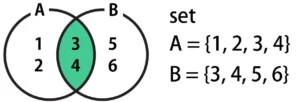
To compute an intersection in Python, place an & between A and B, as shown in the code below.
A = {1, 2, 3, 4}
B = {3, 4, 5, 6}

intersection = A & B
print("intersection:", intersection)  # {3, 4}
How to Find the Difference of Sets in Python: Operator -
The difference returns the range of values that remain when subtracting one set from another.
The difference is expressed using the - operator.
Given sets A and B, the results of A - B and B - A will differ.
Example of Difference A - B in Python
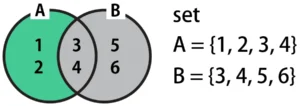
The difference A - B returns the range of values in A with B’s values removed. In the Venn diagram, this is highlighted in green below. Since the values in B (the gray area in the diagram) are excluded, the result is {1, 2} after removing {3, 4} from A.
A = {1, 2, 3, 4}
B = {3, 4, 5, 6}

difference_AB  = A - B
print("difference_AB:", difference_AB)  # {1, 2}
Example of Difference B - A in Python
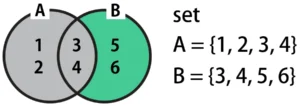
The difference B - A returns the range of values in B with A’s values removed. In the Venn diagram, this is highlighted in green below. Since the values in A (the gray area in the diagram) are excluded, the result is {5, 6} after removing {3, 4} from B.
A = {1, 2, 3, 4}
B = {3, 4, 5, 6}

difference_BA  = B - A
print("difference_BA:", difference_BA)  # {5, 6}
How to Find the Symmetric Difference of Sets in Python: Operator ^
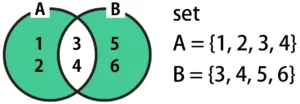
The symmetric difference returns the range of values that are not shared between A and B. In the Venn diagram, this is highlighted in green below.
To compute the symmetric difference in Python, place a ^ (Caret) between A and B, as shown in the code below.
A = {1, 2, 3, 4}
B = {3, 4, 5, 6}

symmetric_diff = A ^ B
print("symmetric_diff:", symmetric_diff)  # {1, 2, 5, 6}